

Why 90% of Startup Pitch Decks Fail—and How Yours Can Succeed
May 23, 2025
By Ashkan Alizadeh — Fund73In this guide:
- Step 1: Get Investor-Ready Before You Reach Out
- Step 2: Build a Targeted Investor List
- Step 3: Warm Intros Beat Cold Emails (But Do Both)
- Step 4: Follow Up Without Being Annoying
- Step 5: Prepare Like a Pro for the Meeting
- Step 6: Build Momentum
- Bonus Tips for First-Time Founders
- The Bottom Line
Getting your first investor meeting can feel like an impossible task when you are just starting out. You have no big-name investors backing you yet, your product is still early, and you might not even have revenue. So why would anyone take a meeting with you?
The good news: plenty of investors do meet with founders at the pre-seed stage. The bad news: most founders approach them the wrong way.
This guide will walk you step-by-step through what you need to prepare, how to find the right investors, and how to secure that first call or coffee meeting that could change everything.
Step 1: Get Investor-Ready Before You Reach Out
A lot of founders rush into outreach before they are ready, and then get ignored. You want to look like a serious, credible founder even if you are still early. Here’s what to have ready:
1. Your Story
Investors need a clear, human reason to care about your startup. This is not just a description of your product, it’s why you exist. Whenever I say story, always remember the shark tank tvshow, when people are coming up with something touching, some motivation of theirs. It is how they pitch their business in the first 30 seconds. It is how you need to have your difference with the other rest of the entrepreneurs, remember you need to shine out of the pile. Now when it comes to questions, here is the important ones that you need to ask yourself.
- Why did you start this?
- Why does this problem matter now?
- Why are you the person to solve it?
2. A Pitch Deck
You do not need a 30-slide masterpiece, in fact if you do a 30 slide pitch deck you will not get any meeting. but you do need something investors can skim in under 4 minutes and understand, what we call this is a pitch deck. My personal advice is to create a pitch deck that will have minimum text, raise interest, if you send a document with full paragraphs like a booklet, the investor will probably close it on after the second page. Let me give you one secret that eery pitch deck needs to offer. The investors care about every slide yes, but at the end of the day there are 3 very important slides you need to offer in a perfect way.
- Your traction. Investors don’t like investing in startups that have literally zero downloads, zero sales and haven’t gone further from the idea stage. If you haven’t put your own money into building your MVP, why would they believe in you? Remember, building a startup is a risky business, we all have to take some risks. If you have zero downloads but 1000 sign ups, that does count too, so you don’t need to have sales at all but letter of intents or signups are counted as traction as well, they basically need to have sonme proof of interest.
- The team. You must have a team that has a relevant experience. I know what you are thinking, but the ivnestors invest in founders not startups, yes that is right, this is why you have to have a team. I wouldn’t recommend you to write yourself as a solo founder. A team looks more attractive trust me. Also, investors don’t care if you have a PHD or if you are from MIT. They care that you know your stuff.
- The milestone, your timeline. Where will you be in 3 years? How much money are you projecting? Investors really want to see your vision, how you will approach on the future plans, how do you think expanding will happen, if you are a dreamer, or a believer. This slide always shows a lot of information about you which will absolutely give the investor everything about you.
So these are the most important 3 slides but other than that, what you need to include is The problem you are solving, Your solution (product). Market size (enough to matter), Business model (how you will make money), The ask (how much you are raising, what for).
Even if your deck is simple, it should look professional. A poorly designed deck signals that you are not taking fundraising seriously.
3. A Crisp One-Liner tweet!
This is the first thing I have learned when I came to silicon valley. A tweet long introduction. It sounded weird but it made all sense later on. When you are introducing your business, you should always be able to do it under a tweet. If you can’t it means you have problems defining your business. When I am teaching founders I always see a very common mistake of founders trying to tell everything up front in millions of words. No! defining something shorter is much harder and it matters a lot. Don’t over compllciate things. So back to the topic, investors talk to each other, and you want them to repeat your one liner, it matters a lot for it to be easy memorable. So, Before you send your deck, you need a single line that explains what you do.
“We are building X for Y so they can Z.”
Example:
“We are building a platform for independent gyms so they can fill empty class spots with last-minute bookings.”
Your one-liner is what investors will repeat to others — make it clear.
Step 2: Build a Targeted Investor List
Not all investors are a fit for pre-seed startups. You want to avoid wasting time pitching people who never invest this early.
Start With These Sources:
- AngelList – Filter investors by stage (pre-seed, seed) and industry
- Crunchbase – Search for companies like yours, see who invested
- Twitter / LinkedIn – Investors talk about deals they do, follow them
- Your Network – Alumni groups, mentors, advisors, LinkedIn connections
Aim to build a list of 30–50 relevant investors. Add columns for:
- Name
- Firm
- Location
- Typical check size
- Stage focus
- Portfolio highlights
- Warm intro path (if any)
This is the difference between random spam and smart, focused outreach.
Step 3: Warm Intros Beat Cold Emails (But Do Both)
The fastest way to get a meeting is a warm intro from someone the investor trusts.
Warm Intros
Ask people you know (mentors, other founders, accelerators) to introduce you. Make it easy for them:
- Write a short blurb they can copy/paste
- Include a link to your deck
- Be clear about your ask (e.g., “We are raising $250K pre-seed, would love to get [Investor]’s thoughts”)
Cold Outreach
If you cannot get intros, send a concise, respectful email or LinkedIn message:
Subject: Pre-Seed Round – [Startup Name]

Body:
Hi [Investor Name],

I am [Your Name], founder of [Startup Name]. We are building [one-liner].

We have [traction – users, revenue, pilot programs, waitlist]. We are raising [$X] pre-seed to [big goal – e.g., launch in 3 new markets].

Here’s our deck: [link]

Would love to get 15 minutes of your feedback or see if this aligns with your focus.

Best,
[Your Name]
Short, clear, respectful. Do not send a 1,000-word life story.
Step 4: Follow Up Without Being Annoying
Investors are busy. If you do not hear back, wait 5–7 days and follow up politely.
Example:
“Hi [Investor], just wanted to follow up in case this slipped through. Would you be open to a 15-minute chat about [your startup]?”
Two follow-ups are fine. If no response after that, move on.
Step 5: Prepare Like a Pro for the Meeting
Once you land that first meeting, do not blow it.
- Know your numbers: CAC, LTV, revenue (or projections), market size
- Know your competitors: Who else is solving this problem? Why you?
- Have a clear ask: Investors hate vague conversations. State how much you are raising and what milestones you will hit with it.
- Practice: Rehearse your pitch out loud, get feedback from friends or other founders.
Remember: the goal of the first meeting is not to close the round. It’s to get them interested enough to want to keep talking.
Step 6: Build Momentum
Fundraising works like dating — one yes leads to more yeses.
- After each meeting, send a thank you email and next steps
- If they pass, ask for feedback — sometimes they will intro you to others
- Share progress updates (“We just closed 20% of our round!”) — investors like to see momentum before committing
Bonus Tips for First-Time Founders
- Social Proof Helps: Even small wins like “accepted into [accelerator name]” or “100 customers signed up in first week” make a difference.
- Leverage Communities: YC’s free Startup School, Indie Hackers, Slack groups — share your journey and you might get intros.
- Be Patient: Pre-seed rounds often take 3–6 months to close. Do not get discouraged if it does not happen in 2 weeks.
The Bottom Line
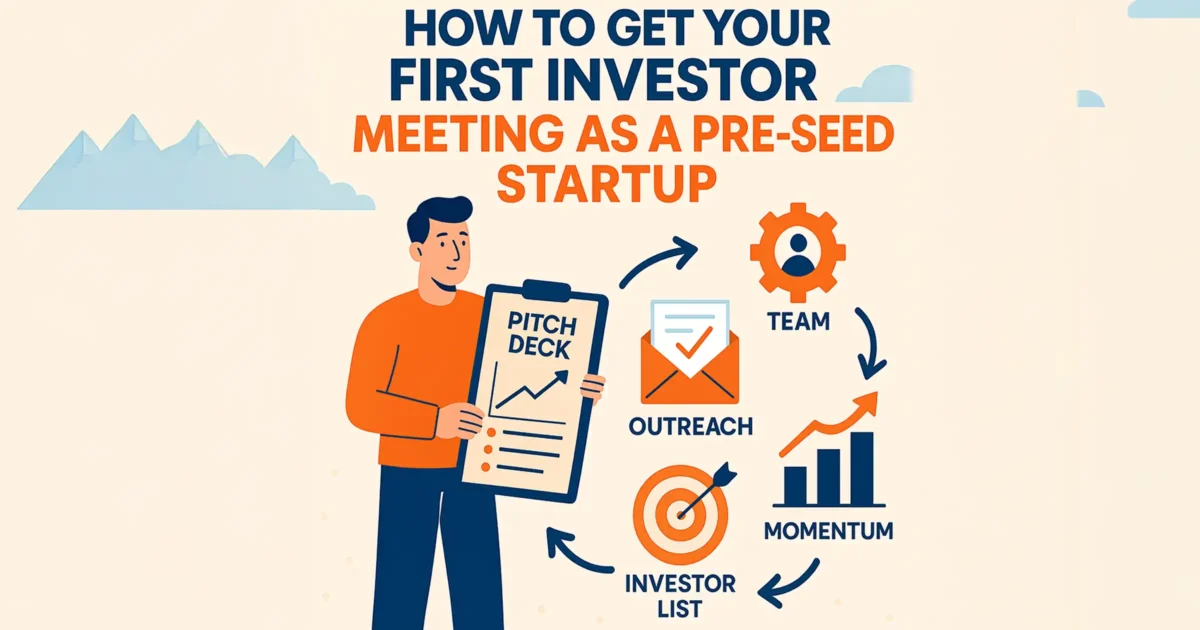
Getting your first investor meeting is not about luck — it is about preparation, targeting, and persistence.
- Make sure your story and deck are investor-ready
- Build a smart, focused investor list
- Use warm intros when you can, cold outreach when you cannot
- Follow up, prepare, and keep building momentum
Your first meeting might not get you a check, but it will get you one step closer to the one that does.
If you want a head start, you can use Fund73’s free pitch deck checklist or book a call with our team to get your story and deck investor-ready.
More from Fund73: Concierge fundraising services · Contact · All articles

1 Comment
Can you check my pitch deck please?